
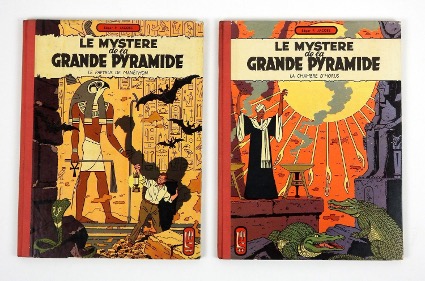
Le mystère de la grande pyramide
Year:
1951
Nationality:
Belgium
Language:
French
Writer:
Edgar P. Jacobs
Artist:
Edgar P. Jacobs
Publisher:
Les Éditions du Lombard
Genre:
Adventure, Noir
Other websites:
Summary
Professor Philip Mortimer has decided to spend his holiday in Cairo with his trusty servant, Nasir. There, he plans to meet his old friend, Professor Ahmed Rassim Bey, who offers him the fantastic opportunity of satisfying his passion for Egyptology. Professor Bey has invited him to take part in deciphering his latest discoveries: in this case, some papyri coming from mummies of the Ptolemaic Period. Mortimer and Bey soon realize that one of the fragments deals with the “Chamber of Horus,” a fabled crypt that could contain priceless treasures...
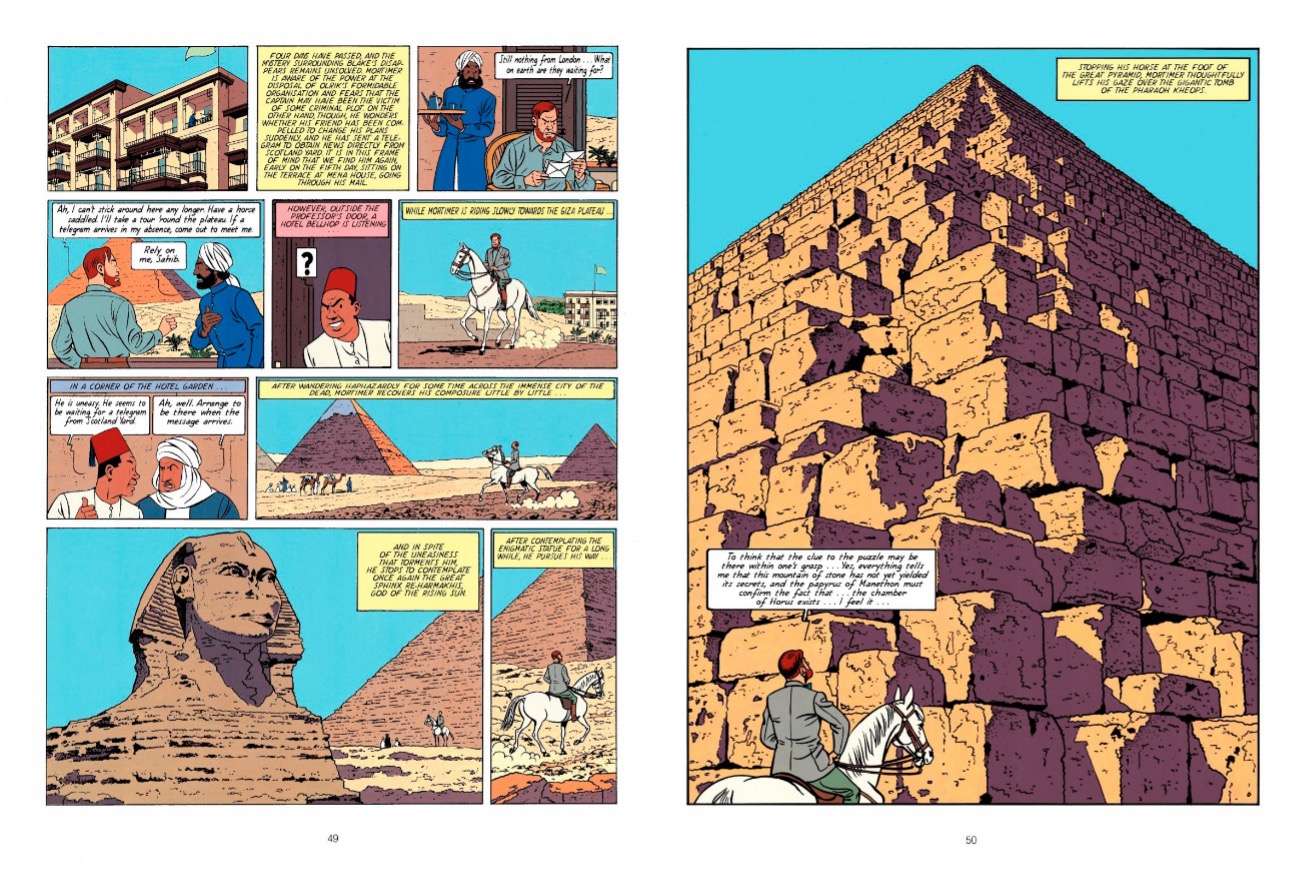
Depictions of the Sphinx and the Pyramid of Cheops in the comic (Screenshot by author)
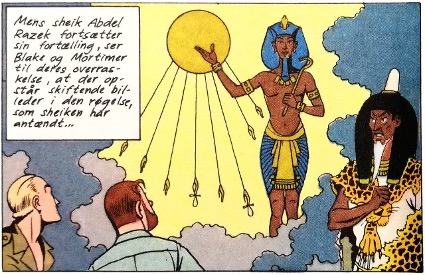
Representation of Akhenathon under the solar disc, in the style of the Amarna period (Screenshot by author)
Egyptomania narratives or motifs
The comic discussed here comprises two volumes. The first is named “Le Papyrus de Manethon”, and the second “La chambre d’Horus”. This comic marks the fourth installment in the Blake and Mortimer series, with its initial publication appearing in the Belgian magazine Tintin in 1946.
In this comic book, Edgar P. Jacobs employs a common plot device found in numerous Western literary works: the unearthing of an ancient manuscript, which serves as the catalyst for the narrative. In this instance, the narrative revolves around a purported manuscript attributed to Manetho, an Egyptian priest and historian who wrote in Greek and lived during the reigns of Ptolemy I and Ptolemy II. The contents of this papyrus hint at a Chamber of Horus concealed within the Great Pyramid. Mortimer speculates that this chamber may house the fabled treasure of Akhenaten.
The storyline unfolds through a high-speed adventure, in which an illicit network involved in trafficking antiquities plays a pivotal role in propelling the plot forward. The climax occurs when Mortimer receives news of his colleague Blake's demise while transiting through Athens airport. This event sets into motion the principal narrative arc of the latter part of the comic: Mortimer must unravel the enigma surrounding the Great Pyramid and seek retribution for his friend's death. As expected, the story reaches its resolution with Mortimer prevailing over those engaged in illegal antiquities dealings.
Edgar Pierre Jacobs was a prominent Belgian cartoonist during the 20th century and had a close relationship with Hergé. Indeed, Jacobs began his career in comics alongside Tintin's creator, collaborating on various aspects of the series. Both cartoonists shared an interest in Egypt, highlighted by Hergé humorously depicting Jacobs inside a sarcophagus on the cover of Les cigars du Pharaon.
It is worth noting the correlation that exists between the Belgian cartoonist behind this comic and the portrayal of narratives starring British protagonists in Egypt. Such portrayals hold a significant place in popular culture, and are exemplified by fictional works such as the books written by Agatha Christie. The narrative style of the comic also draws parallels with the storytelling found in tales featuring Holmes and Watson, as well as the TV series Doctor Who. The influence of these elements from popular culture should not be underestimated in shaping a collective perception of ancient cultures.
The theme of realism and historical accuracy is prominently featured in this comic. The initial pages of its first volume are dedicated to providing background information on the history of Cheops' Great Pyramid.
Edgar P. Jacobs employs the portrayal of renowned pieces of Egyptian art history to enhance the historical authenticity of the narrative. In a scene where Professor Mortimer explores the Egyptian Museum in Cairo, notable artifacts such as the colossal statue of Amenhotep III and Tiye (ca. 1360 BCE), the colossal statue of Akhenaten (ca. 1353-1336 BCE), the statues of Rahotep and Nofret (ca. 2575-2551 BCE), and the small ivory statuette of Cheops (ca. 2589 - 2566 BCE) are showcased. This comic strip provides readers with an opportunity to admire some of the most iconic treasures housed in the Egyptian Museum in Cairo, which were already on display back in the 1950s. Additionally, it presents a distinct depiction of Cairo during that era, with Mortimer lodging at one of its prominent establishments, the now-demolished Continental Savoy hotel. Daniel Becerra and Soraya Jorge elucidated how the illustrations featured in this comic accurately represented scenes from the Egyptian Museum in Cairo, offering readers a compelling virtual tour through its halls.
With regards to the portrayal of Ancient Egypt within this comic, it is essential to highlight that the narrative unfolds in contemporary Egypt, predominantly set in Cairo. The depiction of Ancient Egypt is primarily limited to iconic landmarks and objects, such as those housed in the Egyptian Museum in Cairo and the pyramids situated within the Giza necropolis. These representations are portrayed with a high degree of realism. When discussing funerary artifacts, the historical source results to be the treasures found in Tutankhamun's tomb. Furthermore, it is noteworthy how the distinctive body forms characteristic of the art from the Amarna period are accurately depicted.
In this comic book, Edgar P. Jacobs employs a common plot device found in numerous Western literary works: the unearthing of an ancient manuscript, which serves as the catalyst for the narrative. In this instance, the narrative revolves around a purported manuscript attributed to Manetho, an Egyptian priest and historian who wrote in Greek and lived during the reigns of Ptolemy I and Ptolemy II. The contents of this papyrus hint at a Chamber of Horus concealed within the Great Pyramid. Mortimer speculates that this chamber may house the fabled treasure of Akhenaten.
The storyline unfolds through a high-speed adventure, in which an illicit network involved in trafficking antiquities plays a pivotal role in propelling the plot forward. The climax occurs when Mortimer receives news of his colleague Blake's demise while transiting through Athens airport. This event sets into motion the principal narrative arc of the latter part of the comic: Mortimer must unravel the enigma surrounding the Great Pyramid and seek retribution for his friend's death. As expected, the story reaches its resolution with Mortimer prevailing over those engaged in illegal antiquities dealings.
Edgar Pierre Jacobs was a prominent Belgian cartoonist during the 20th century and had a close relationship with Hergé. Indeed, Jacobs began his career in comics alongside Tintin's creator, collaborating on various aspects of the series. Both cartoonists shared an interest in Egypt, highlighted by Hergé humorously depicting Jacobs inside a sarcophagus on the cover of Les cigars du Pharaon.
It is worth noting the correlation that exists between the Belgian cartoonist behind this comic and the portrayal of narratives starring British protagonists in Egypt. Such portrayals hold a significant place in popular culture, and are exemplified by fictional works such as the books written by Agatha Christie. The narrative style of the comic also draws parallels with the storytelling found in tales featuring Holmes and Watson, as well as the TV series Doctor Who. The influence of these elements from popular culture should not be underestimated in shaping a collective perception of ancient cultures.
The theme of realism and historical accuracy is prominently featured in this comic. The initial pages of its first volume are dedicated to providing background information on the history of Cheops' Great Pyramid.
Edgar P. Jacobs employs the portrayal of renowned pieces of Egyptian art history to enhance the historical authenticity of the narrative. In a scene where Professor Mortimer explores the Egyptian Museum in Cairo, notable artifacts such as the colossal statue of Amenhotep III and Tiye (ca. 1360 BCE), the colossal statue of Akhenaten (ca. 1353-1336 BCE), the statues of Rahotep and Nofret (ca. 2575-2551 BCE), and the small ivory statuette of Cheops (ca. 2589 - 2566 BCE) are showcased. This comic strip provides readers with an opportunity to admire some of the most iconic treasures housed in the Egyptian Museum in Cairo, which were already on display back in the 1950s. Additionally, it presents a distinct depiction of Cairo during that era, with Mortimer lodging at one of its prominent establishments, the now-demolished Continental Savoy hotel. Daniel Becerra and Soraya Jorge elucidated how the illustrations featured in this comic accurately represented scenes from the Egyptian Museum in Cairo, offering readers a compelling virtual tour through its halls.
With regards to the portrayal of Ancient Egypt within this comic, it is essential to highlight that the narrative unfolds in contemporary Egypt, predominantly set in Cairo. The depiction of Ancient Egypt is primarily limited to iconic landmarks and objects, such as those housed in the Egyptian Museum in Cairo and the pyramids situated within the Giza necropolis. These representations are portrayed with a high degree of realism. When discussing funerary artifacts, the historical source results to be the treasures found in Tutankhamun's tomb. Furthermore, it is noteworthy how the distinctive body forms characteristic of the art from the Amarna period are accurately depicted.
Author: Guillermo Juberías
Other information
Miller, A. (2009). "The Astonishing Return of Blake and Mortimer: Francophone Fantasies of Britain as Imperial Power and Retrospective Rewritings", in: L. Plate & A. Smelik (eds), Technologies of Memory in the Arts. London, Palgrave Macmillan.
Open access
Tags
Write a Comment
Tem de iniciar a sessão para publicar um comentário.