
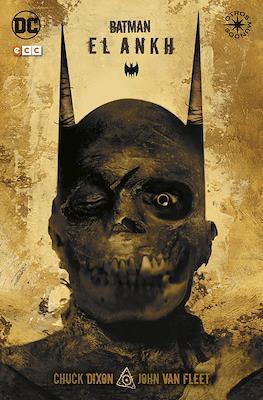
Batman: The Ankh
Year:
2001
Nationality:
USA
Language:
English
Writer:
Chuck Dixon
Artist:
John van Fleet
Publisher:
DC Comics
Genre:
Adventure, Noir
Other websites:

Summary
The acclaimed team that brought you Batman: The Chalice reunites for a 2-part tale involving ancient Egypt, immortals, magic, and a crime spree that has existed for centuries. When some of Gotham's wealthiest citizens start vanishing without a trace, along with some Egyptian artifacts, Batman traces the crimes to an immortal woman with a haunting past and a deadly agenda! (League of comic geeks).
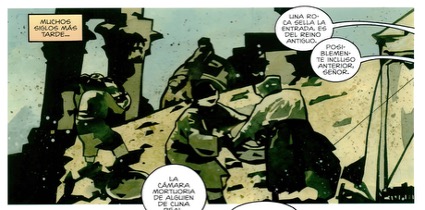
Archaeological excavation in Egypt at the ruins of the tomb where Khatera lies (Screenshot by author)
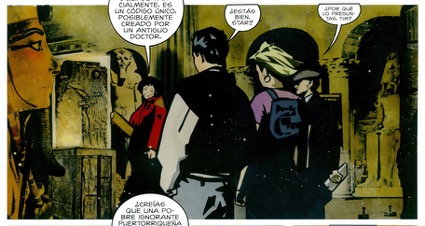
Tim (Robin) visits the Gotham Museum of Antiquities and observes an Egyptian stele (Screenshot by author)
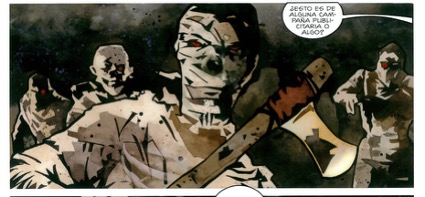
The mummies of Khatera attack the museum (Screenshot by author)
Egyptomania narratives or motifs
With a clearly biblical inspiration at its outset, featuring the death of the pharaoh's firstborn son as a victim of a plague, Batman: The Ankh presents a plot connecting the ancient world and the present through the figure of the sorceress Khatera. From a visual standpoint, there are abundant Egyptian references, both during the passages set directly in ancient Egypt and later, mainly focused on pieces from Gotham's museum of antiquities. The technique used by the comic's creators is interesting, as they use real images of Egyptian monuments and objects (often coloured photographs) to bring greater realism to the comic's sequences. This means that some of the objects are clearly recognisable to an expert eye, such as the bust of Akhenaten from the Cairo Museum, wall paintings from the tomb of Nebamun (TT17) from the New Kingdom, or columns clearly inspired by the temple of Kom Ombo. In this sense, Batman: The Ankh becomes a paratextual divertissement for Egyptologists.
As for the plot, it recovers many of the elements of nineteenth- and twentieth-century mummy fiction, with an untouched tomb containing an immortal being who is freed after the reckless intervention of Western archaeologists. From that moment on, the monster is free and travels to Gotham. But the monster here is not monstrous; rather, it takes the form of a young woman who, without arousing any suspicion, begins to hatch various plans to achieve a goal that is not intrinsically negative: she wants to discover the secrets of death so that she too can die and obtain eternal rest. To this end, she founds a clinic for the terminally ill, with whom she creates mummies that roam Gotham in search of ancient artefacts and documents dealing with death. As a worshipper of Anubis, her role as a doctor to the dying and her research into death is entirely consistent.
Batman's role in this story is to uncover and foil Khatera's plans, weaving this quest for mortality into a plot of suspense and investigation so typical of the DC Comics character.
In addition to the frequent Egyptian-inspired visual elements, there is a notable reference to the Nile flood, which is given an interesting narrative justification in the context of Gotham. Thus, the ancient city would have been destroyed by an earthquake, with the new city being rebuilt on top of the old one, which was then completely buried and invisible to its inhabitants. This underground city was partially flooded and inhabited by crocodiles, giving it an undeniable Nilotic component.
As for the plot, it recovers many of the elements of nineteenth- and twentieth-century mummy fiction, with an untouched tomb containing an immortal being who is freed after the reckless intervention of Western archaeologists. From that moment on, the monster is free and travels to Gotham. But the monster here is not monstrous; rather, it takes the form of a young woman who, without arousing any suspicion, begins to hatch various plans to achieve a goal that is not intrinsically negative: she wants to discover the secrets of death so that she too can die and obtain eternal rest. To this end, she founds a clinic for the terminally ill, with whom she creates mummies that roam Gotham in search of ancient artefacts and documents dealing with death. As a worshipper of Anubis, her role as a doctor to the dying and her research into death is entirely consistent.
Batman's role in this story is to uncover and foil Khatera's plans, weaving this quest for mortality into a plot of suspense and investigation so typical of the DC Comics character.
In addition to the frequent Egyptian-inspired visual elements, there is a notable reference to the Nile flood, which is given an interesting narrative justification in the context of Gotham. Thus, the ancient city would have been destroyed by an earthquake, with the new city being rebuilt on top of the old one, which was then completely buried and invisible to its inhabitants. This underground city was partially flooded and inhabited by crocodiles, giving it an undeniable Nilotic component.
Author: Abraham I. Fernández Pichel
Tags
Write a Comment
Tem de iniciar a sessão para publicar um comentário.