
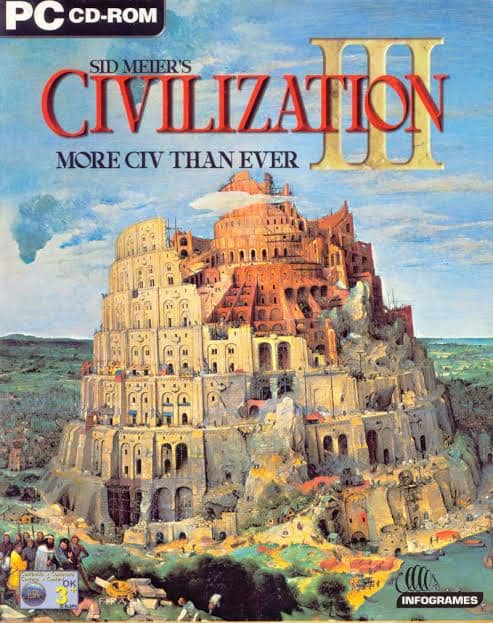
Sid Meier’s Civilization III
Game Family:
Sid Meier's Civilization
Year:
2001
Nationality:
USA
Authors:
Roger Briggs & Mark Cromer
Designer:
Jeff Briggs & Soren Johnson
Artists:
Publisher:
Infogrames
Number of Players:
Single Player
Genre:
Turn-based strategy, 4x
Other websites:

Videos by players:

Summary of the game
The third installment of the Civilization video game series, Civilization III (abbreviated Civ III) is a turn-based strategy video game (meaning players plan their moves in turns) where the player is able to act as the ruler of one of a variety of civilizations as they lead them through various periods of development (from the rise of civilizations around 4000 BCE to the Space Age). This series pioneered the “4X” style of gameplay, in which players explore land, expand into new territories, exploit resources, and exterminate opposing civilizations.
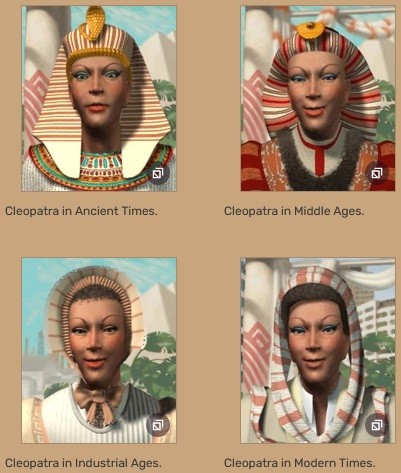
Screenshot of the Kleopatra avatar through the various Civ ages. (Screenshot by author of an image compilation from the Civ III fandom wiki: https://civilization.fandom.com/wiki/Cleopatra_(Civ3))
Egyptomania narratives or motifs
In this game, Egypt is a playable civilization, led by Kleopatra VII, and with a default capital city at Thebes. The Kleopatra avatar is represented by a portrait of the queen in which she initially wears an Egyptian nemes headdress and pectoral collar, but, as the player transitions the civilization through the various ages, her clothing changes to correlate to the various historical periods (see screenshot). She does keep her distinctive cat-eye eyeliner, however, which seems to be the feature the game designers used to identify this avatar wtih the famous queen. Here also, Kleopatra is not depicted as beautiful, as avatars of the queen often are in other video games of this period, which is a notable difference.
When playing as the Egyptian civilization there is not a lot that distinguishes the gameplay as uniquely Egyptian, other than interacting with Kleopatra as the civilization’s leading avatar. The player progresses through the same gameplay, the same technological advancements, and the same technological periods as they would with any of the other civilizations. In military units, players who select to play as the Egyptian civilization are able to build war chariots, rather than the chariots that the other civilizations can produce.
Similar to previous installments of the game, in Civ III, players can still build a Wonder once they reach a higher level of in-game knowledge. The Wonder for the Egyptian civilization is still a Pyramid, and, just as in Civ II, rather than being a burial monument (although this is still acknowledged in the civilopedia), the Pyramid Wonder grants agricultural bonuses and allows the player to build a free granary in each of their cities. A new feature of this Wonder is that it also becomes a tourist attraction, once it exists for over 1000 in-game years, which attracts additional commerce to the city. This seems to be a nod to the real-world role of the Great Pyramid as an important tourist attraction and source of income for Egypt.
New Wonders related to Egypt include the Great Lighthouse, which grants a bonus to seafaring and culture, and is identified in its civilopedia entry with the Pharos of Alexandria, and the Great Library, which grants a bonus to culture, and is identified in its civilopedia entry with the Great Library of Alexandria. As with the Pyramid Wonder, these can both be built by any civilization and can also become tourist attractions.
When playing as the Egyptian civilization there is not a lot that distinguishes the gameplay as uniquely Egyptian, other than interacting with Kleopatra as the civilization’s leading avatar. The player progresses through the same gameplay, the same technological advancements, and the same technological periods as they would with any of the other civilizations. In military units, players who select to play as the Egyptian civilization are able to build war chariots, rather than the chariots that the other civilizations can produce.
Similar to previous installments of the game, in Civ III, players can still build a Wonder once they reach a higher level of in-game knowledge. The Wonder for the Egyptian civilization is still a Pyramid, and, just as in Civ II, rather than being a burial monument (although this is still acknowledged in the civilopedia), the Pyramid Wonder grants agricultural bonuses and allows the player to build a free granary in each of their cities. A new feature of this Wonder is that it also becomes a tourist attraction, once it exists for over 1000 in-game years, which attracts additional commerce to the city. This seems to be a nod to the real-world role of the Great Pyramid as an important tourist attraction and source of income for Egypt.
New Wonders related to Egypt include the Great Lighthouse, which grants a bonus to seafaring and culture, and is identified in its civilopedia entry with the Pharos of Alexandria, and the Great Library, which grants a bonus to culture, and is identified in its civilopedia entry with the Great Library of Alexandria. As with the Pyramid Wonder, these can both be built by any civilization and can also become tourist attractions.
Author: Tara Sewell-Lasater
Tags
Write a Comment
Tem de iniciar a sessão para publicar um comentário.