
The Secret of the Court: A Romance of Life and Death
Year:
1895
Author:
Frank Frankfort Moore
Contry:
Ireland
Language:
English
Publisher:
Forgotten Books
Genre:
Historical fiction, Mystery
Other websites:

Summary
Lady Ursula is a beautiful and intelligent woman who finds herself caught up in a dangerous game of politics and power at the royal court of England. As she navigates the treacherous waters of court life, Lady Ursula discovers a dark secret that threatens to destroy everything she holds dear. Set in the late 19th century, The Secret Of The Court takes readers on a journey through the opulent halls of Buckingham Palace and the treacherous streets of London. With vivid descriptions and richly drawn characters, the novel paints a vivid picture of life in Victorian England. At its heart, The Secret Of The Court is a romance novel, filled with passion, intrigue, and betrayal. Lady Ursula must navigate a complex web of relationships, including a forbidden love affair with a handsome young man named Lord Bracondale (Amazon.es).
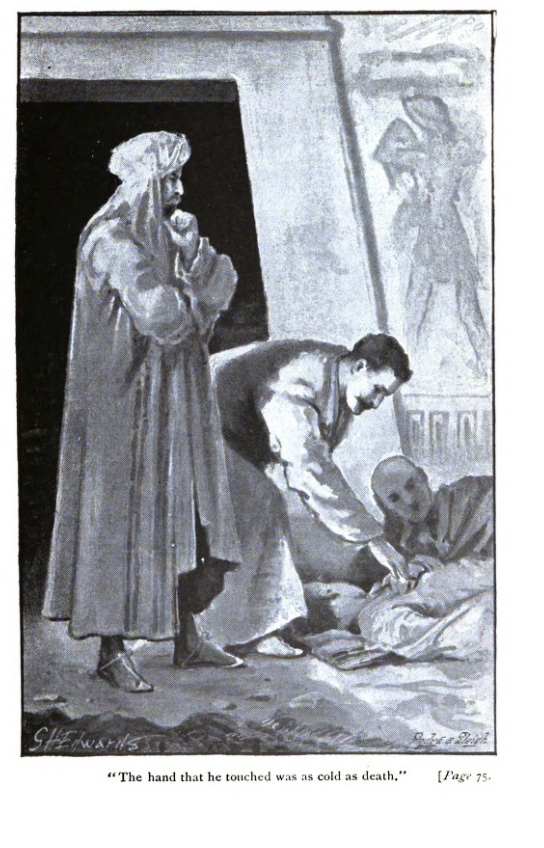
An illustration by George Henry Edwards depicting Sefton and Hampden in the Temple of Hevoth, with priests in a death-like state prior to reanimation in the bottom right (Source: https://babel.hathitrust.org/cgi/pt?id=nyp.33433074905005&seq=91&view=1up)
Egyptomania narratives or motifs
Moore’s 1895 novel opens with Major Arthur Hampden robbed by a trio of Bedouins in the desert. Suffering a blow to the head, he awakens inside a subterranean Egyptian temple, where his wounds are tended by one of his old army comrades (Rodney Sefton) and other mysterious men in white robes. Formerly a medical doctor, Sefton, we learn, retired from medicine to take up Egyptology. Sefton reveals to Hampden that they are in the Court of the Thousand Pillars – part of the Temple of Hevoth (a ‘father of all gods’ invented for this novel), this ancient site having been revealed to him by a High Priest, the worship of Hevoth having continued since antiquity. Moore establishes an origin story for ancient Egyptian religion that dovetails with biblical narratives, with Sefton claiming that ‘Many of the early pages of the book of Genesis were […] written in this Temple.’ Among the episodes during which Hampden recuperates in the Temple of Hevoth: Sefton serves Hampden the variety of wine in which Cleopatra was said to have dissolved pearls; Sefton speculates as to soon illuminating the secrets of the Pyramids and the Great Sphinx; Sefton reveals that priests of Hevoth reside around the world in the Himalayas, Afghanistan, Ceylon and – less exotic – Kent; and Hampden observes wall decorations depicting the megatherium, revealing that ancient Egyptians (or their forerunners) and dinosaurs co-existed, and that Assyrian sphinxes are also depicted, revealing them to be an as-yet undiscovered species rather than a mythological invention. Hampden’s first foray to other areas of the vast temple network culminates in the revelation that ancient priests of Hevoth exist in huge numbers in a state of suspended animation in a particular chamber. Returning to this chamber alone at nighttime, Hampden sees the once inert figures seemingly restored to life, assuming a geometric formation, chanting a hymn to Hevoth, and performing a ritual dance. Despite the mysteries Hampden has witnessed, he leaves Sefton and the Temple temporarily to pursue the woman he loves who is holidaying in Cairo, though it transpires that while Hampden has been recovering she has accepted a proposal of marriage from his brother. Hampden returns to Sefton.
In the second part of the novel Sefton and Hampden visit the priest of Hevoth residing in Kent, where Sefton consults tablets that reveal to him the secrets of life and death. The rest of the novel concerns a secret attempt to restore life to Hampden’s recently deceased sister-in-law. After his labouring at this unholy task, Sefton, notably, is left ‘closely resemb[ling] one of the mummies, among which […] he had passed the best days of his life’, while other references to Egyptian mummies are made when other characters comment on Hampden’s own devotion to Egyptological pursuits: the ‘fellow […] made me believe that his whole heart had been transferred to an Egyptian mummy’. Hampden’s bereaved brother is seen with the doppelganger of his deceased wife, which leads other characters to think he is engaging in an affair with a lookalike. At the novel’s conclusion it is implied that the experiment to revive her has not gone to plan, producing a soulless body and a disembodied soul. This is not confirmed, however, as the tower in which the experiment took place burns down after being struck by lightning, and one presumes Hampden’s brother and his beloved (in whatever form she existed) do not survive.
The text’s depiction of ancient Egyptian culture – and a culture that predates ancient Egypt – is one which replicates many of the tropes and stereotypes common to nineteenth-century popular culture. The idea of secrets to be deciphered hidden in magical texts features strongly, as does the idea of scientific knowledge available to the ancients which modern civilisation is attempting to rediscover. The connection the text makes between Asian civilisations and Egypt suggests Theosophical influences, while the idea of ancient Egypt being far older than known records suggest chimes with alternative theories as to the age of humankind which still resonate in fringe or pseudoarchaeology today. The text it also noteworthy for its depictions of the priests of Hevoth putting themselves into a state of suspended animation or else awakening periodically from the dead before returning to this state, and its imagining of ancient Egyptian mummification practices as a debased form of this. While the priests are not reanimated mummies (a more popular trope in Gothic or science fiction literature of the time), there is a zombie-like quality to them, and certainly to the modern woman whose body is experimented on in the novel’s second part, in which life is restored to the body but the soul remains separate.
In the second part of the novel Sefton and Hampden visit the priest of Hevoth residing in Kent, where Sefton consults tablets that reveal to him the secrets of life and death. The rest of the novel concerns a secret attempt to restore life to Hampden’s recently deceased sister-in-law. After his labouring at this unholy task, Sefton, notably, is left ‘closely resemb[ling] one of the mummies, among which […] he had passed the best days of his life’, while other references to Egyptian mummies are made when other characters comment on Hampden’s own devotion to Egyptological pursuits: the ‘fellow […] made me believe that his whole heart had been transferred to an Egyptian mummy’. Hampden’s bereaved brother is seen with the doppelganger of his deceased wife, which leads other characters to think he is engaging in an affair with a lookalike. At the novel’s conclusion it is implied that the experiment to revive her has not gone to plan, producing a soulless body and a disembodied soul. This is not confirmed, however, as the tower in which the experiment took place burns down after being struck by lightning, and one presumes Hampden’s brother and his beloved (in whatever form she existed) do not survive.
The text’s depiction of ancient Egyptian culture – and a culture that predates ancient Egypt – is one which replicates many of the tropes and stereotypes common to nineteenth-century popular culture. The idea of secrets to be deciphered hidden in magical texts features strongly, as does the idea of scientific knowledge available to the ancients which modern civilisation is attempting to rediscover. The connection the text makes between Asian civilisations and Egypt suggests Theosophical influences, while the idea of ancient Egypt being far older than known records suggest chimes with alternative theories as to the age of humankind which still resonate in fringe or pseudoarchaeology today. The text it also noteworthy for its depictions of the priests of Hevoth putting themselves into a state of suspended animation or else awakening periodically from the dead before returning to this state, and its imagining of ancient Egyptian mummification practices as a debased form of this. While the priests are not reanimated mummies (a more popular trope in Gothic or science fiction literature of the time), there is a zombie-like quality to them, and certainly to the modern woman whose body is experimented on in the novel’s second part, in which life is restored to the body but the soul remains separate.
Author: Eleanor Dobson
Other information
Borwein, N. S. 2021. The Oriental World of Egyptian Gothic, in C. Bloom (ed.) The Palgrave Handbook of Steam Age Gothic : 235-261. London: Palgrave.
Access with registration and payment.
Murray, P. 2022. F. Frankfort Moore (1855-1931)”. The Green Book: Writings on Irish Gothic Supernatural and Fantastic Literature 20: 96-102.
Access with registration and payment.
Tags
Write a Comment
Tem de iniciar a sessão para publicar um comentário.