
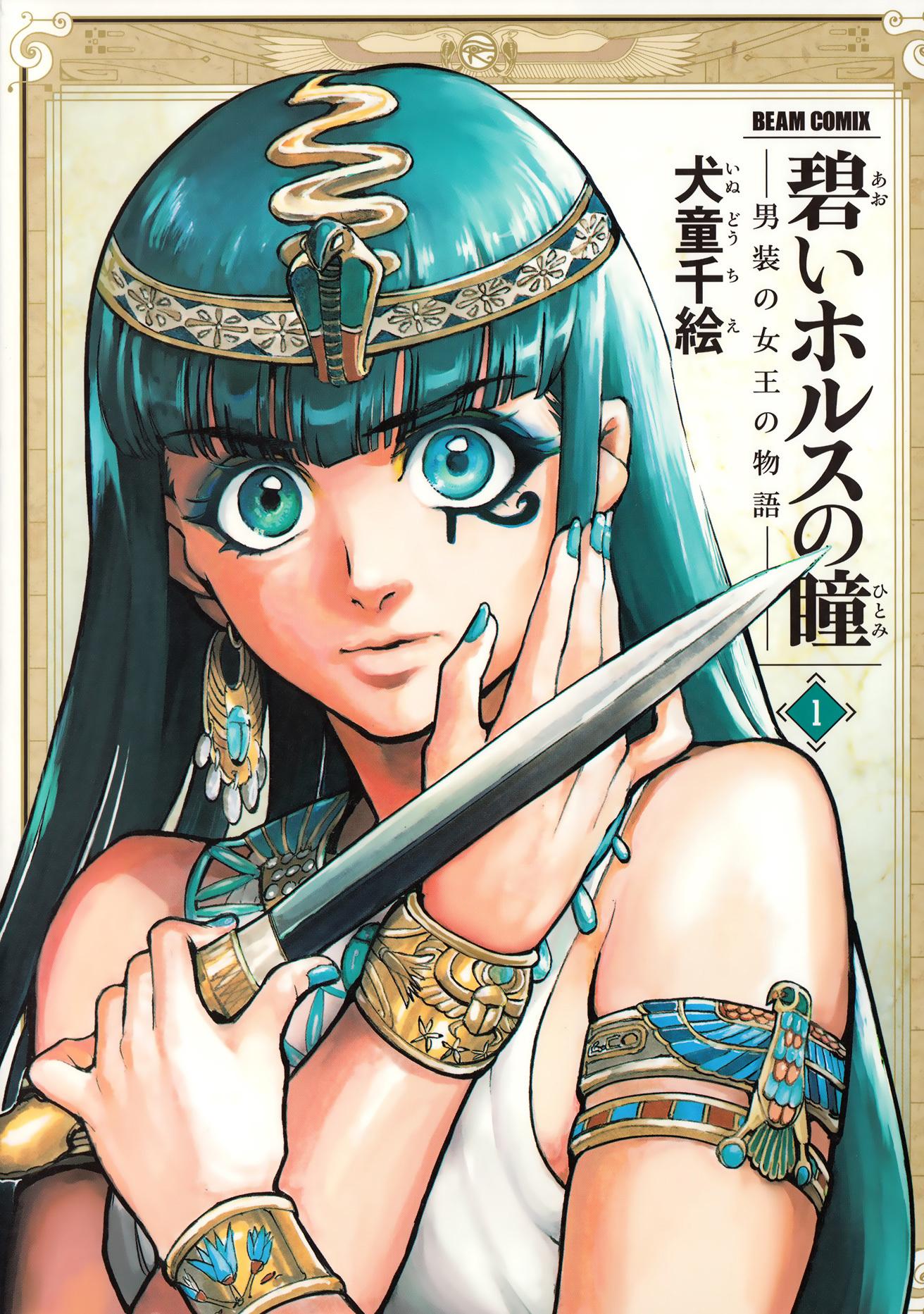
Aoi Horus no Hitomi (The Blue Eye of Horus: The Story of a Queen Dressed as a Man)
Year:
2014-2021
Nationality:
Japan
Language:
Japanese
Writer:
Inudoh Chie
Artist:
Inudoh Chie
Publisher:
Enterbrain
Genre:
Drama, Romance, Seinen
Other websites:
Summary
Aoi Horus no Hitomi: Dansou no Joou no Monogatari (碧いホルスの瞳 -男装の女王の物語-), also known as The Blue Eye of Horus: The Story of a Queen Dressed as a Man, is a manga series which focuses on Hatshepsut’s rise to power.
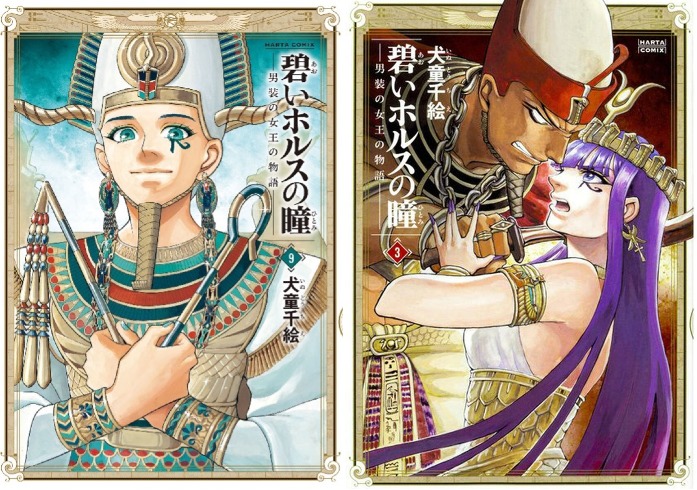
Hatshepsut wearing pharaonic regalia: the atef crown, the royal beard, the heqa sceptre and the nekhekh flail (Source: https://mangadex.org/) and Hatshepsut and Thutmosis II (Source: https://mousiemanga.wordpress.com/)
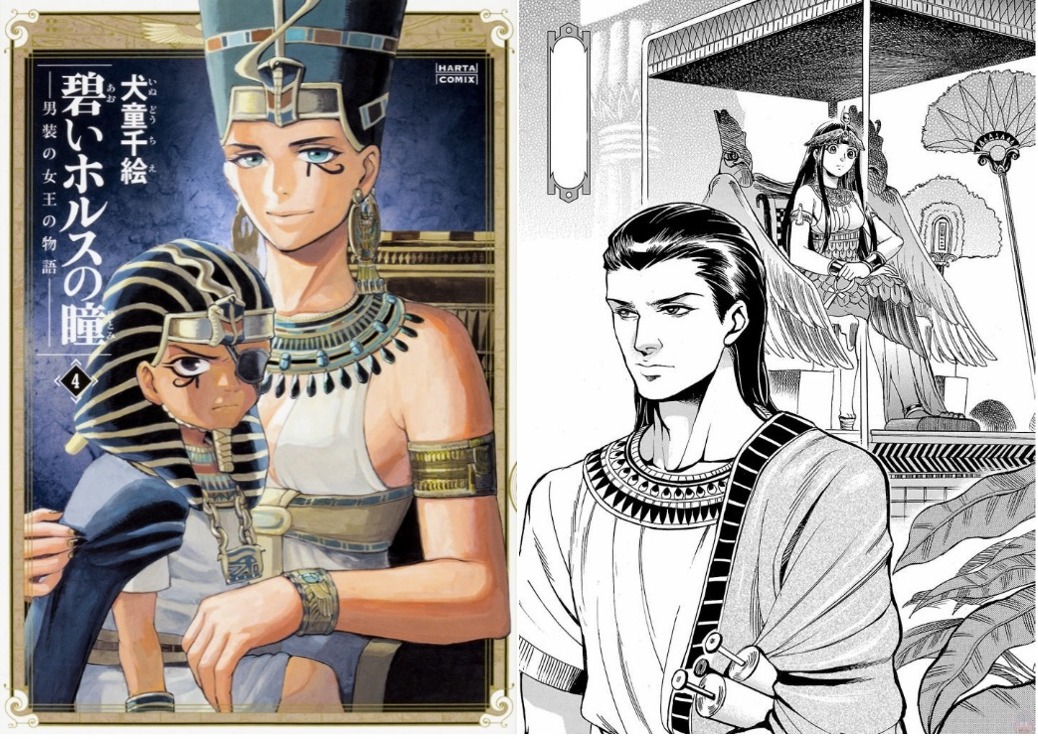
Cover of number 4 of the manga in Japan showing Hatshepsut as regent and young Thutmosis III (left) (Source: https://static.zerochan.net/) and Hatshepsut and Senenmut (right) (Source: https://static.wikia.nocookie.net/)
Egyptomania narratives or motifs
The story begins with the proclamation of Thutmosis II as new pharaoh of Egypt and the marriage between Thutmosis II and Hatshepsut (Chapters 1-4), followed by Hatshepsut’s political struggles (Chapters 5-13) and her rise to the throne as regent with Thutmosis III (Chapters 14-40). From the beginning of the story, Hatshepsut is presented as a tomboy kind of girl who prefers hunting and fighting to “female” activities and who rebels against the idea of not being able to become pharaoh just because she is a woman. She is especially opposed to the idea of her half-brother, Thutmosis II (called Seti in the manga before his coronation), becoming pharaoh, for he is depicted as an arrogant, tyrannical and womanizer man who spends most of his days either laying with women or in campaigns against Kush. Whereas we don’t have much information about the relationship between the real Thutmosis II and Hatshepsut, Hatshepsut appears frequently from the beginning of Thutmosis II’s reign in wall reliefs accompanying her husband and even by herself, which attests to her importance even during her short brother’s reign. Thutmosis II’ military efforts were also moderate compared to his father and his son, as opposed to what is shown in the manga, but it is true that some expeditions against Nubian rebels were carried out during his rule.
To emphasize Thutmosis II’ role as a villain who enjoys mercilessly killing people in war and capturing slaves (Chapter 4-5) and who is unfit to rule Egypt, Hatshepsut is presented as an intelligent and caring woman who rejects the idea of slavery and war (Chapter 6) and who aims to make Egypt a kingdom based on trade and diplomacy, especially with the kingdoms of Punt (Chapters 3 & 4) and Mitanni (Chapter 11). Undoubtedly, her fascination with Punt and trade comes from her own wall reliefs at Deir el-Bahri.
Hatshepsut counts with the help of some allies, like Tabia, a delicate Teban dancer, Sirtre, her maidservant, and Senenmut, her loyal advisor who is also in love with her. However, she must also deal with some adversaries such as her own half-brother, who blackmails her to have a child with him in exchange for her sister’s life; the High Priest of Amun Snerseth, who is presented as a scheming individual; or Sothis, Thutmosis II’s favourite concubine and priestess of Isis (a reference to Iset, Thutmosis III’s mother), who is depicted as a sexualized woman who manipulates men by using her charms.
References to Egyptian life, religion and mythology are constantly depicted in the manga: in the first pages of the manga Hatshepsut’s divine birth by Amun-Ra and her mother Ahmose is described (Chapter 1), and she appears frequently in the back covers and extra pages of the manga accompanied by several gods such as Horus, Amun-Ra, Seth or Hathor. Chapter 2 focuses on the death of Ahmose and explains the process of mummification: whereas the information given is based on Herodotus’ account, priests with masks of Anubis conducting the ritual, canopic jars and female mourners are also presented. In Chapter 4 & 8, Senenmut and Hatshepsut have a conversation while playing senet, whereas in Chapter 5 New Year is celebrated with the appearance of the star Sothis in the sky and the beginning of the akhet season. Daily lives of construction workers, midwifes and weavers are represented in Chapters 5, 7 & 11. Finally, references to Egyptian and Kushite places, such as Thebes, Avaris or Wawat are also mentioned in the manga.
Some orientalist motives can also be observed in the manga: characters that are supposed to be “good”, such as Hatshepsut, Tabia or Senenmut are depicted in a white, lighter skin and light or blue eyes. In opposition, villains or supportive characters who nonetheless belong to a lower social rank, such as Thutmosis II, Sothis, maidservants, workers, slaves, weavers and dancers, are depicted with darker features. Furthermore, both the pharaoh and the priests of Amun’s vices and excesses with women (Chapter 6), wealth, scheming, and alcohol points back to the idea of a decadent East.
At the end of each volume the manga also includes little extra stories called Anubis knows everything! where a cartoon-ish version of the god Anubis dressed in modern clothes (with a tie featuring the ankh) and holding the was scepter explains different aspects of Ancient Egyptian society and mythology.
Author: Esperanza Macarena Ródenas Perea
Citation:
Ródenas Perea, E. M., 2026, Aoi Horus no Hitomi. In A. I. Fernández Pichel (ed.), Egypopcult Project Database, Lisboa.
URL: https://lisboadatabase.egypopcultlisboa.pt/aoi-horus-no-hitomi-the-blue-eye-of-horus-the-story-of-a-queen-dressed-as-a-man/
Ródenas Perea, E. M., 2026, Aoi Horus no Hitomi. In A. I. Fernández Pichel (ed.), Egypopcult Project Database, Lisboa.
URL: https://lisboadatabase.egypopcultlisboa.pt/aoi-horus-no-hitomi-the-blue-eye-of-horus-the-story-of-a-queen-dressed-as-a-man/
Other information
Persi, C. 2027 (in press). The Blue Eye of Horus: The manga tribute to Hatshepsut by Chie Inudoh, in A.I. Fernández Pichel (ed.) Present Lives of Ancient Times. The Reception of Antiquity in Contemporary Popular Culture. Sheffield: Equinox.
Not available
Tags
Write a Comment
Tem de iniciar a sessão para publicar um comentário.