Age of Mythology
Game Family:
Age of Empires
Year:
2002
Nationality:
USA
Authors:
Robert Fermier
Designer:
Ian M. Fischer, Bruce Shelley
Artists:
Lance Hoke, David Cherry
Publisher:
Microsoft Game Studios, Ensemble Studios, Westlake Interactive
Number of Players:
Single Player, Multiplayer
Genre:
Real Time Strategy
Other websites:

Videos by players:

Summary of the game
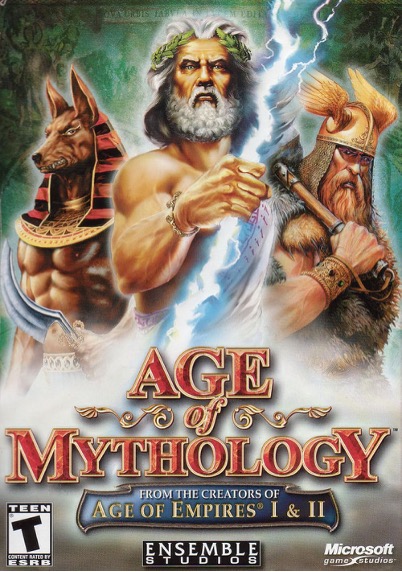
Age of Mythology is an RTS (Real Time Strategy) game in which players must manage resources to build structures and units in order to achieve victory by conquering other players and taking control of their town centre. This may also involve forming alliances with other players. At the beginning of a game, the player selects a major god, which allows the player access to unique upgrades, buildings or units. Throughout the game, the player selects minor gods to worship, which allows further access to different types of units and buildings. Also important to the gameplay are God Powers, which generally buff the player or debuff other players’ units or buildings. As well as a lengthy campaign, there are custom scenarios to play through, and online multiplayer. The base game was released in 2002 on PC and Mac, but has subsequently been released on Nintendo DS as Age of Empire: Mythologies in 2008, and Xbox Series X and PS5 in 2024. Expansions include Age of Mythology: The Titans (2003) and Tale of the Dragon (2016), which added the Atlantean and Chinese cultures to the existing Egyptian, Greek and Norse cultures.
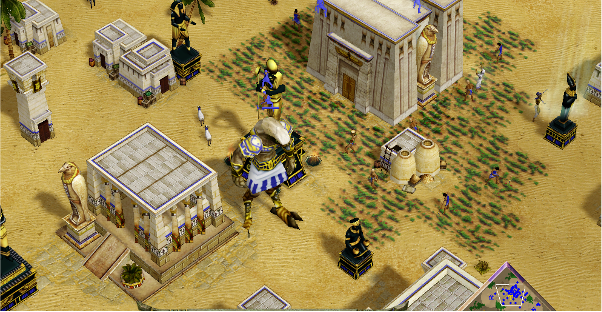
Egyptianising characters and places in Age of Mythology (Screenshot by author)
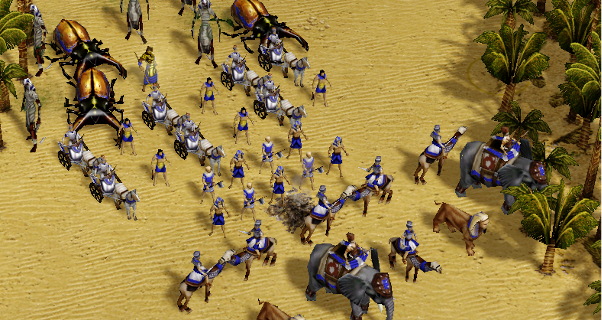
Egyptianising army according to Age of Mythology (Screenshot by author)
Egyptomania narratives or motifs
As one of the playable groups, the Egyptians can choose between three major gods; Ra, Isis and Set. During the course of the game, the player can also choose to worship minor gods including Anubis, Bast, Ptah, Hathor, Nephthys, Sekhmet, Horus, Osiris and Thoth. In the selection of these gods, the player unlocks access to mythical units and upgrades which are largely drawn from Egyptian mythology, though mixed with popular conceptions of ancient Egypt.
For instance, the player can unlock the Sphinx unit, which is definitively the Egyptian rather than Greek conception of the mythical creature. However, one of the upgrades to the Sphinx allow it to gain the head of a hawk, bringing to mind the western obsession with the “composite” theriomorphic gods. One of the God Powers allows the player’s Pharaoh to be turned into the son of Osiris (Horus), which demonstrates the historically-attested kinship between Horus and the Pharaoh, and the former’s importance in kingship ideology. Nonetheless, one of the possible units is a mummy, which is the classic shambling, pestilential mummy of popular conceptions in films and literature.
What is particularly interesting is that in the game’s guide there are notes concerning the various gods and their mythological stories, which give the player access to a lot of information which is drawn from a variety of sources including the Papyrus of Ani, specific archaeological objects such as stela, and ancient literature such as Sophocles’ Oedipus Rex. We see then an effort to provide the player with mythologically (and sometimes historically) accurate information, but which is often adapted and repurposed to make the game more interesting and novel.
A good example is that the campaign has an Egyptian-themed section where the player must reunite parts of the god Osiris’s body, which has clear parallels in authentic Egyptian mythology. Nonetheless, given that the game also includes Greek and Norse playable cultures, this is sandwiched into the story between the Trojan war and Ragnarok, linked by a plot formulated by the titan Cronos to escape his imprisonment in Tartarus.
For instance, the player can unlock the Sphinx unit, which is definitively the Egyptian rather than Greek conception of the mythical creature. However, one of the upgrades to the Sphinx allow it to gain the head of a hawk, bringing to mind the western obsession with the “composite” theriomorphic gods. One of the God Powers allows the player’s Pharaoh to be turned into the son of Osiris (Horus), which demonstrates the historically-attested kinship between Horus and the Pharaoh, and the former’s importance in kingship ideology. Nonetheless, one of the possible units is a mummy, which is the classic shambling, pestilential mummy of popular conceptions in films and literature.
What is particularly interesting is that in the game’s guide there are notes concerning the various gods and their mythological stories, which give the player access to a lot of information which is drawn from a variety of sources including the Papyrus of Ani, specific archaeological objects such as stela, and ancient literature such as Sophocles’ Oedipus Rex. We see then an effort to provide the player with mythologically (and sometimes historically) accurate information, but which is often adapted and repurposed to make the game more interesting and novel.
A good example is that the campaign has an Egyptian-themed section where the player must reunite parts of the god Osiris’s body, which has clear parallels in authentic Egyptian mythology. Nonetheless, given that the game also includes Greek and Norse playable cultures, this is sandwiched into the story between the Trojan war and Ragnarok, linked by a plot formulated by the titan Cronos to escape his imprisonment in Tartarus.
Author: Lawrence Webb
Tags
Write a Comment
Tem de iniciar a sessão para publicar um comentário.