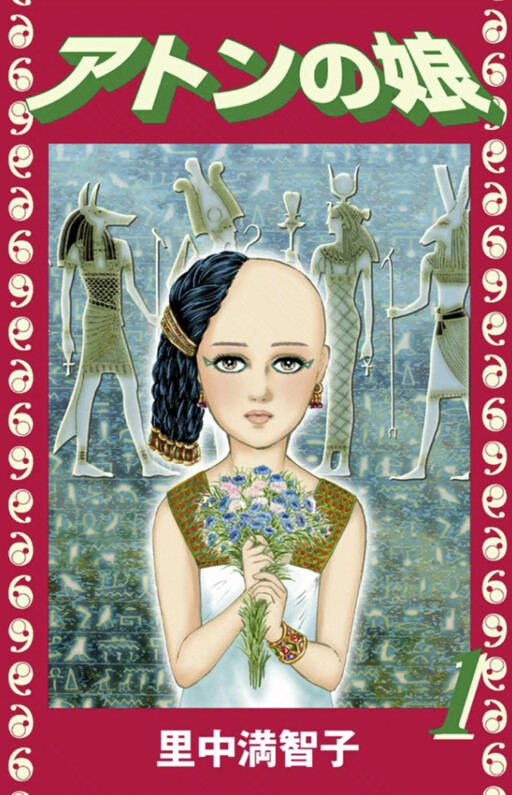
Aton no Musume (Daughter of Aton)
Year:
1993-1994
Nationality:
Japan
Language:
Japanese
Writer:
Machiko Satanoka
Artist:
Machiko Satanoka
Publisher:
Big Gold
Genre:
Historical, Drama
Other websites:
Summary
Aton no Musume or Daughter of Aton is a manga written and illustrated by Machiko Satonaka. This manga was produced in 1993/1994 and is an historical work that transports the readers to the heart of one of the most transformative periods of ancient Egypt, the Amarna period.
Divided in three volumes, at its core, the manga follows the life of Ankhesenamun, the daughter of Pharaoh Akhenaten and Queen Nefertiti, as she navigates a world shaped by political changes, religious reform, and personal sacrifice. Ankhesenamun’s life unfolds against the backdrop of her father’s radical attempt to revolutionize Egyptian society by replacing the long-standing polytheistic religion with monotheism centered on Aton.
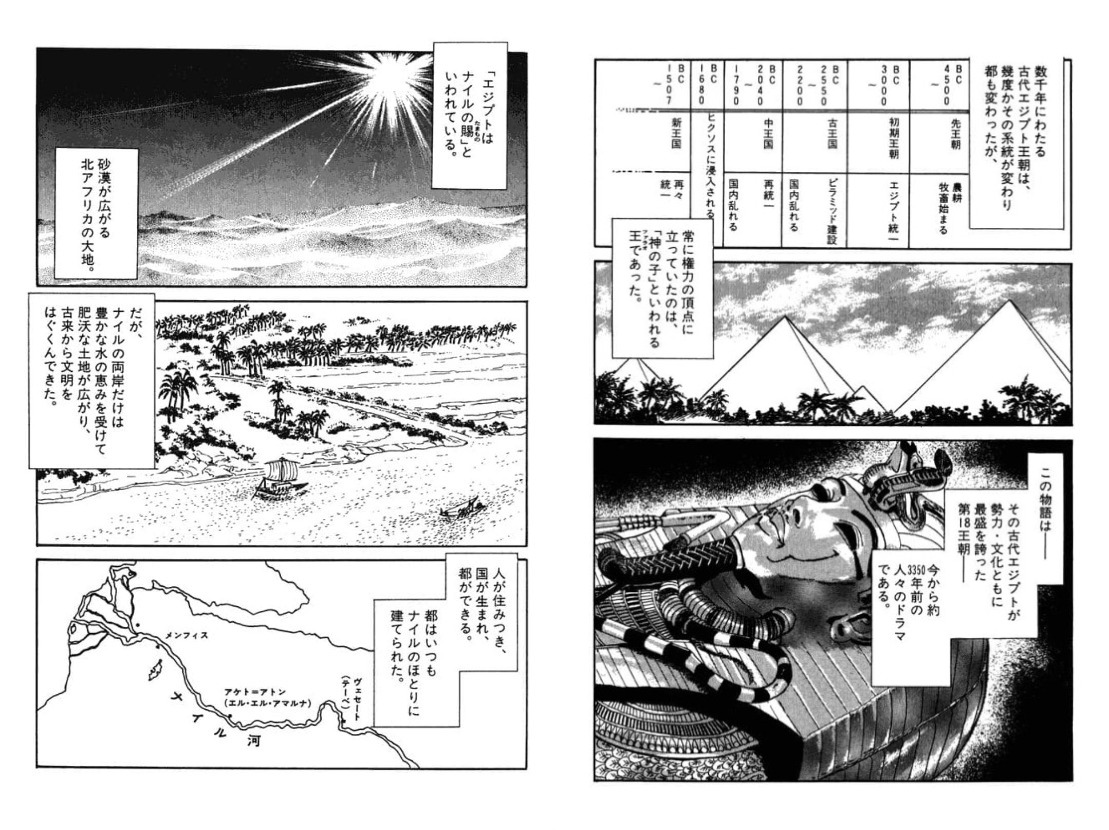
First page of the first volume: an introduction to Egypt and its land (links) and Basic information on the Egyptian royal dynasties (right) (Screenshots by author)
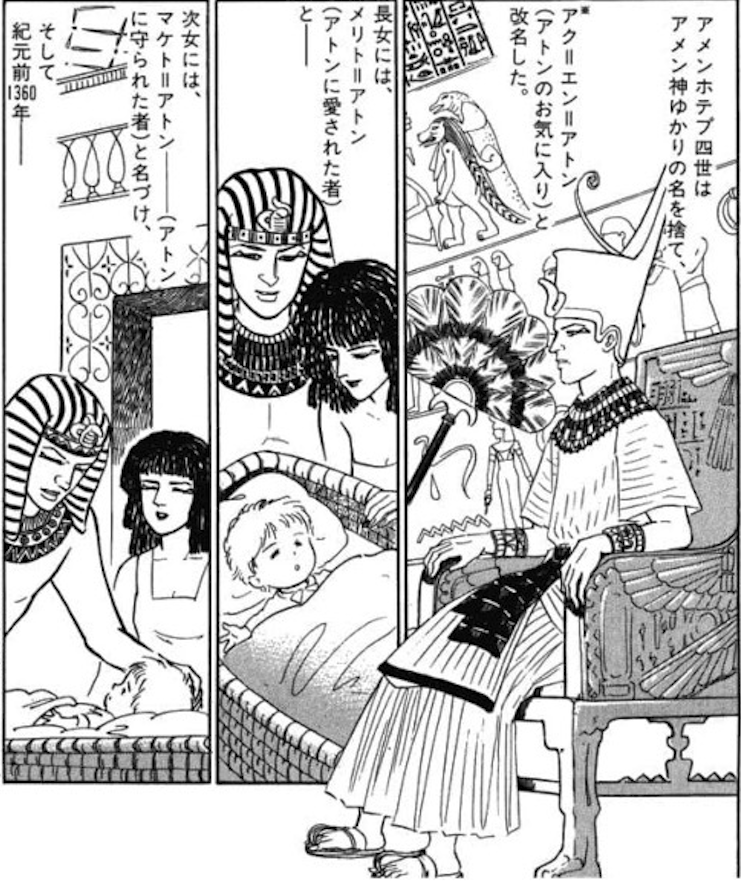
Akhenaton, Nefertiti, and baby Ankhesenamun (Screenshot by author)
Egyptomania narratives or motifs
The narrative ends up shining in its portrayal of Ankhesenamun’s growth and challenges. From her youth in the opulent yet tense royal court to her role as queen alongside her husband, Tutankhamun, Ankhesenamun’s character development is both compelling and deeply human. While the story is developing, we understand that Ankhesenamun embodies the conflict between personal desires and the heavy burdens of duty, particularly as she finds herself caught between loyalty to her father’s vision and the societal demand to restore traditional beliefs. Her marriage to Tutankhamun further complicates her life, as the young couple struggles to bring stability to a fractured kingdom, while facing the manipulation of powerful court figures and the looming threat of external forces.
One of the factors that sets this manga apart is Satonaka’s ability to recreate historical events, while also letting her creativity mold the events and the figures. Although there is the concern of historical accuracy, there is also the imagination of the interactions and the dialogues. Given this concern, the manga is more than a mere recounting of history; it provides a deeply emotional and introspective lens into the lives of individuals grappling with immense change, and that is where the creative part takes place. Ankhesenamun’s internal struggles, such as her efforts to balance her role as a queen with her personal identity, resonate universally, making her story both timeless and relatable. Themes of resilience, love, loss, and survival echo throughout the narrative, ensuring the reader remains engaged on multiple levels.
Visually, the manga can be considered a feast for the eyes. Satonaka’s artwork captures the grandeur and intricacies of ancient Egypt, from its majestic palaces and temples to the finely detailed costumes adorned with what we can assume would be gold and lapis lazuli. Her commitment to historical accuracy enhances the story’s authenticity, while her expressive character designs convey the emotional depth of each figure. The visual storytelling heightens the tension of pivotal moments, such as Ankhesenamun’s private confrontations with her parents or her public role in the political theater of the royal court.
Ultimately, Aton no Musume is a masterful blend of historical narrative and dramatic storytelling. By focusing on Ankhesenamun, a figure often overlooked in traditional accounts of ancient Egypt, Satonaka offers a fresh and different perspective on this fascinating period of history, making it more accessible and maybe entertaining for the Japanese public. The manga not only immerses readers in the splendor and turmoil of ancient Egypt but also invites them to reflect on universal themes of identity, power, and the human cost of revolution. It stands as a testament to Satonaka’s skill as both a storyteller and an artist, making it a must-read for fans of historical fiction and manga alike, who know Japanese.
One of the factors that sets this manga apart is Satonaka’s ability to recreate historical events, while also letting her creativity mold the events and the figures. Although there is the concern of historical accuracy, there is also the imagination of the interactions and the dialogues. Given this concern, the manga is more than a mere recounting of history; it provides a deeply emotional and introspective lens into the lives of individuals grappling with immense change, and that is where the creative part takes place. Ankhesenamun’s internal struggles, such as her efforts to balance her role as a queen with her personal identity, resonate universally, making her story both timeless and relatable. Themes of resilience, love, loss, and survival echo throughout the narrative, ensuring the reader remains engaged on multiple levels.
Visually, the manga can be considered a feast for the eyes. Satonaka’s artwork captures the grandeur and intricacies of ancient Egypt, from its majestic palaces and temples to the finely detailed costumes adorned with what we can assume would be gold and lapis lazuli. Her commitment to historical accuracy enhances the story’s authenticity, while her expressive character designs convey the emotional depth of each figure. The visual storytelling heightens the tension of pivotal moments, such as Ankhesenamun’s private confrontations with her parents or her public role in the political theater of the royal court.
Ultimately, Aton no Musume is a masterful blend of historical narrative and dramatic storytelling. By focusing on Ankhesenamun, a figure often overlooked in traditional accounts of ancient Egypt, Satonaka offers a fresh and different perspective on this fascinating period of history, making it more accessible and maybe entertaining for the Japanese public. The manga not only immerses readers in the splendor and turmoil of ancient Egypt but also invites them to reflect on universal themes of identity, power, and the human cost of revolution. It stands as a testament to Satonaka’s skill as both a storyteller and an artist, making it a must-read for fans of historical fiction and manga alike, who know Japanese.
Author: Catarina Madeira
Tags
Write a Comment
Tem de iniciar a sessão para publicar um comentário.