
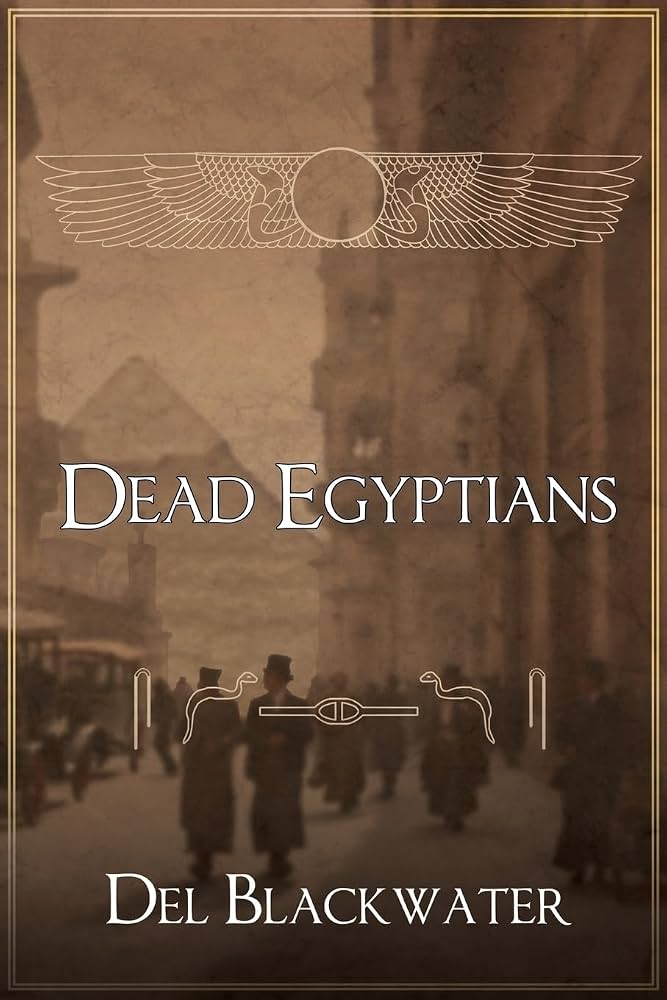
Dead Egyptians
Year:
2024
Author:
Del Blackwater
Contry:
USA
Language:
English
Publisher:
Black Rose Writing
Genre:
Historical fiction, Paranormal, Romance
Other websites:

Summary
In Egypt, all things are possible. So discovers Albion Stanley, a recent Cambridge graduate and brilliant linguist, newly arrived in Cairo in 1902. Albion sees the unseen, including ghosts. It is a less than comfortable reality, which he tends to with copious amounts of whiskey and numerous other vices.
Also in Cairo is Aleister Crowley, the famed occultist. Aleister is a dangerous man, but not an unsympathetic one and never a dull one. Together, they discover the world of dead Egyptians, some of whom are older than the pyramids.
Dead Egyptians have a lot to say. They are deeply unsatisfied with the state of modern Egypt, yet, for all their wisdom and power, they have limitations. As a Seer, Albion proves indispensable to both Crowley and the dead Egyptians.
Dead Egyptians transports the reader into a glittering turn of the century Cairo, while also addressing the atrocities of colonialism. It is hedonistic, while also exploring the complex world of Ancient Egyptian religious thought. It is historically accurate down to the fabrics, while remaining fantastical at its core. (https://delblackwater.com/)
Egyptomania narratives or motifs
Dead Egyptians is Del Blackwater’s first novel and the first in a series that will soon be continued with a second instalment, Sekhem. The novel’s main character is Albion, who visits Egypt as a child and demonstrates a special connection with the country through his ability to see things that ordinary people cannot perceive. This marks his first encounter with an elderly Egyptian man. These two central characters will meet again decades later: Albion, now a linguist at Cambridge, and the elderly man, who appears somewhat different. This reunion, at the start of the 20th century, serves as an initiation for Albion, who hopes to find answers to his ability to see the ghosts of Egypt’s past. This bridge between the past and the present is the very same one that Aleister Crowley—one of the real-life figures the novel weaves into its fiction—is able to build; he will quickly forge a powerful bond with Albion during their time together in Cairo (and even before that).
There are, therefore, two interconnected periods in Egyptian history: on the one hand, Pharaonic Egypt – primarily the Old Kingdom, though not limited to this period – and, on the other, early 20th-century Egypt, with the British presence and that of other European powers on Egyptian soil. The author has drawn on these two significant periods to construct a story of love and learning that will bind together the fates of Albion and Imhotep and their confrontation with Aleister. Similarly, the novel highlights Egypt’s return to the spotlight during a period—such as the early 20th century—when Egypt was not strictly speaking Egyptian, but fell under the sphere of influence of the British Empire. Therefore, the temporal connection between the present and the past is also a rebirth of Egyptian identity, which, far from fading away, remains latent in the contemporary world.
Albion’s ability to see the unseen – the power or ‘shine’ he possesses (borrowing the term used by Stephen King in his 1977 novel The Shining) – sets him apart as someone special. The novel will gradually unravel the nature of this gift, which links Albion himself to ancient Egypt and to a love that spans the ages. Nothing is as it seems, and each character is the reincarnation of a past that some of them have not forgotten and wish to reclaim in the present. Albion, Djoser, Imhotep and Aleister are thus scattered points in a global world that interconnect to restore the true Egypt.
In terms of setting, the novel is essentially set in early 20th-century Egypt, with ancient Egypt being evoked through its ruins and its characters. A particularly successful touch is the figure of the great pharaoh Seti, who makes few but compelling appearances. Various Egyptian gods also feature – or rather, figures from Egypt’s past who have become deities – a device that appears in other works of contemporary popular culture, such as the RPG universe “World of Darkness”, for example. There is also no shortage of characters linked to archaeology, although in this case the approach is more interesting and less stereotypical, featuring a good friend of Albion’s who, despite his academic appearance, is an antiquities dealer – a fact that gives rise to all manner of considerations regarding Egypt’s cultural heritage and its preservation.
Last but not least, Dead Egyptians can be described as a ‘queer novel’. The love between its main characters and their sexual encounters with one another and others are numerous, and introduce an interesting reinterpretation of the relationship between the famous pharaoh Djoser and his architect Imhotep. The two were once lovers, and with each death and reincarnation they seek to re-establish their romantic bond in different times and places.
Personally, I would be remiss not to mention the role of the library, which houses the knowledge of an era and which will remind quite a few people of the library in Umberto Eco’s novel The Name of the Rose. I hope it continues to play a significant role in future instalments of the series.
There are, therefore, two interconnected periods in Egyptian history: on the one hand, Pharaonic Egypt – primarily the Old Kingdom, though not limited to this period – and, on the other, early 20th-century Egypt, with the British presence and that of other European powers on Egyptian soil. The author has drawn on these two significant periods to construct a story of love and learning that will bind together the fates of Albion and Imhotep and their confrontation with Aleister. Similarly, the novel highlights Egypt’s return to the spotlight during a period—such as the early 20th century—when Egypt was not strictly speaking Egyptian, but fell under the sphere of influence of the British Empire. Therefore, the temporal connection between the present and the past is also a rebirth of Egyptian identity, which, far from fading away, remains latent in the contemporary world.
Albion’s ability to see the unseen – the power or ‘shine’ he possesses (borrowing the term used by Stephen King in his 1977 novel The Shining) – sets him apart as someone special. The novel will gradually unravel the nature of this gift, which links Albion himself to ancient Egypt and to a love that spans the ages. Nothing is as it seems, and each character is the reincarnation of a past that some of them have not forgotten and wish to reclaim in the present. Albion, Djoser, Imhotep and Aleister are thus scattered points in a global world that interconnect to restore the true Egypt.
In terms of setting, the novel is essentially set in early 20th-century Egypt, with ancient Egypt being evoked through its ruins and its characters. A particularly successful touch is the figure of the great pharaoh Seti, who makes few but compelling appearances. Various Egyptian gods also feature – or rather, figures from Egypt’s past who have become deities – a device that appears in other works of contemporary popular culture, such as the RPG universe “World of Darkness”, for example. There is also no shortage of characters linked to archaeology, although in this case the approach is more interesting and less stereotypical, featuring a good friend of Albion’s who, despite his academic appearance, is an antiquities dealer – a fact that gives rise to all manner of considerations regarding Egypt’s cultural heritage and its preservation.
Last but not least, Dead Egyptians can be described as a ‘queer novel’. The love between its main characters and their sexual encounters with one another and others are numerous, and introduce an interesting reinterpretation of the relationship between the famous pharaoh Djoser and his architect Imhotep. The two were once lovers, and with each death and reincarnation they seek to re-establish their romantic bond in different times and places.
Personally, I would be remiss not to mention the role of the library, which houses the knowledge of an era and which will remind quite a few people of the library in Umberto Eco’s novel The Name of the Rose. I hope it continues to play a significant role in future instalments of the series.
Author: Abraham I. Fernández Pichel
Tags
Write a Comment
Tem de iniciar a sessão para publicar um comentário.